
Oct
Sometimes, it is difficult to tell how air purifiers help their owners to improve their health, and how bad air quality could damage a person’s health over a long period of time.
In this post, we take a look at the long-term health impacts from exposure to high PM2.5 concentrations, and some steps you could take to protect you and your family from these effects.
What is PM2.5?
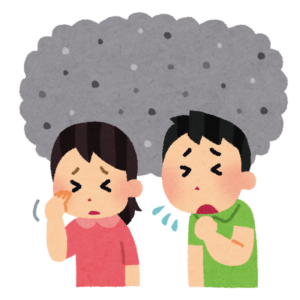
PM2.5 refers to particulate matter in the air that are generally 2.5 micrometers or smaller. They could come in different forms, such as haze, pollen, traffic, industrial exhaust, and tobacco smoke. These tiny particles are invisible to the naked eye. After inhaling PM2.5, these particles can travel around your body through your bloodstream, potentially causing damage to your organs.
While the WHO (World Health Organization) recommends people to keep their exposure to PM2.5 to 15 ug/m³ over 24 hours and 5 ug/m³ over 1 hour, there is no such thing as a “safe limit” for PM2.5. This means that the less PM2.5 you breathe in, the less impact it will have on your health.
How bad is PM2.5?
To visualize the long term health impacts from PM2.5, we can use cigarettes as an example.
Researchers from Berkeley Earth proposed that, for every 22 ug/m³ of PM2.5 that a person is continuously exposed to over the course of a year, they suffer from the health consequence equivalent of smoking one cigarette a day over a year.
| PM2.5 exposure a day over one year | Long term health impact in the form of cigarettes a day over one year |
|---|---|
| 22 ug/m³ | 1 |
| 44 ug/m³ | 2 |
| 66 ug/m³ | 3 |
| 88 ug/m³ | 4 |
| 100 ug/m³ | 4.55 |
| 150 ug/m³ | 6.82 |
| 200 ug/m³ | 9.09 |
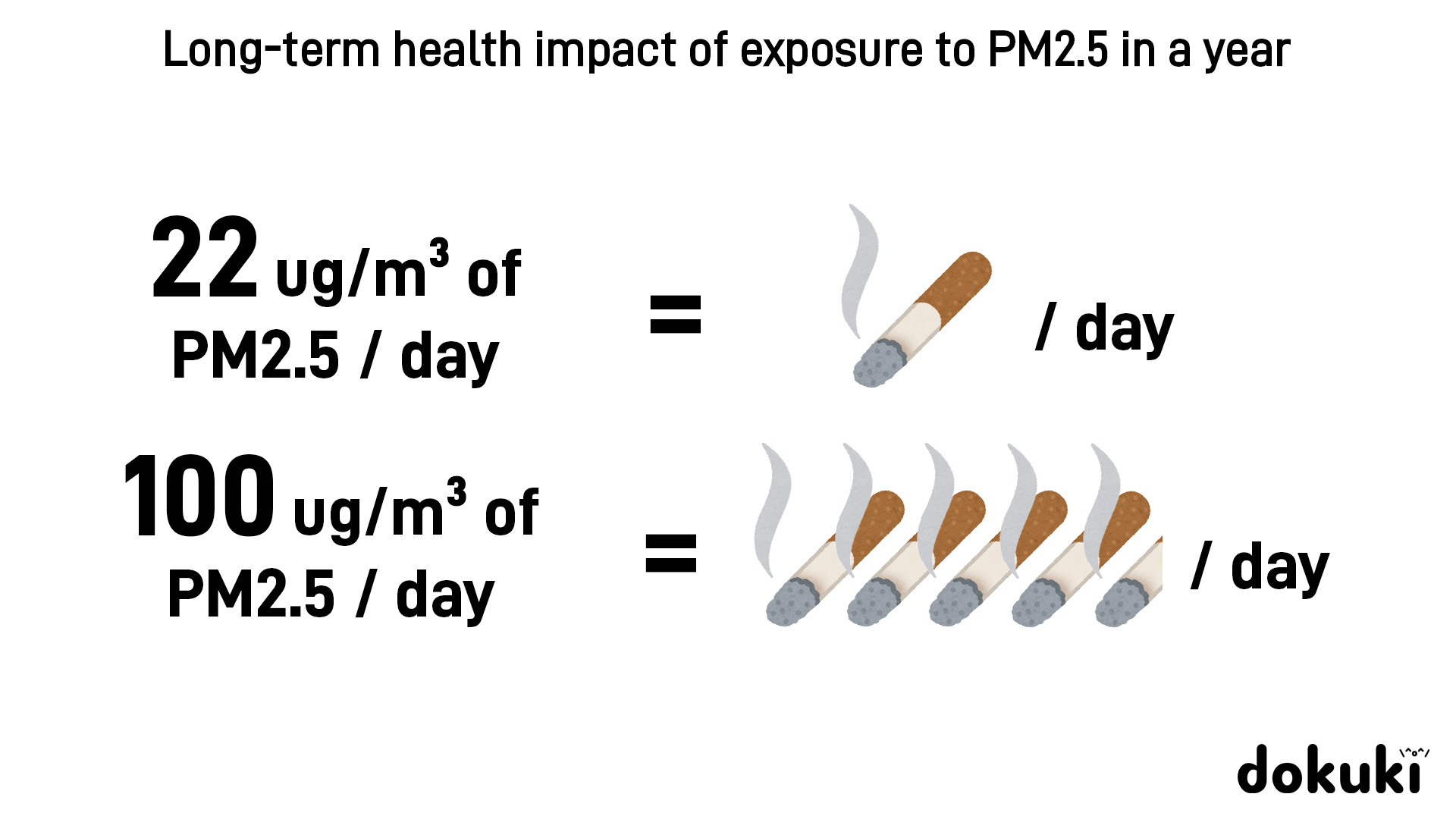
This means that, even for a person that doesn’t smoke (that includes young children and babies), they could end up developing long-term health problems such as cardiovascular disease, dementia, and cancer, just because they are exposed to 22 ug/m³ of PM2.5 a day (equivalent to smoking one cigarette a day) over a long period of time.
Contrary to popular belief, inhalation of PM2.5 would not just affect one’s lungs, but other parts of the body. In addition, high exposure to PM2.5 is a problem that not just affects the elderly, children, and immunocompromised, but also healthy adults as well as animals.
Of course, in countries where air pollution is much worse, being exposed to say, 100 ug/m³ a day, would be equivalent to smoking 4.55 cigarettes a day.
The study from Berkeley Earth shows that even if you are a non-smoker, you could end up developing long-term health problems just by being exposed to high levels of PM2.5. Even under normal environmental conditions (i.e. no haze), it’s not very hard to encounter a PM2.5 level of 22 ug/m³ or higher outdoors, especially in areas near roads and traffic.
Where can PM2.5 be found?

PM2.5 can be found both indoors and outdoors. It is a potential problem indoors especially if the windows are opened, there is a lack of ventilation, there is a lack of air cleaning, or if your home is located near a road, expressway, or industrial area. Outdoors, it could come from sources such as haze, traffic, and tobacco smoke.
How can PM2.5 be measured?
PM2.5 can easily be measured anytime, anywhere with the help of a air quality monitor. Ensure that the air quality monitor you’re buying is reliable, because options that are cheaper in the market tend not to give accurate readings. We recommend the AirFanta G3 (coming soon), which could not only show PM1.0, PM2.5, and PM10 readings, but also HCHO (formaldehyde) and CO2 (carbon dioxide) readings as well.
Some room air purifiers, such as the AirFanta 5Pro, come with built-in sensors that measure and display the PM2.5 concentration in the room.
How to reduce PM2.5 indoors?
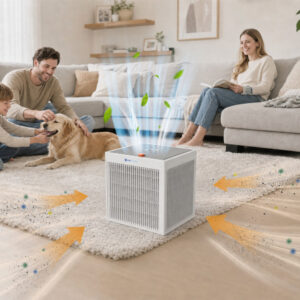
There are a couple of ways to reduce your exposure to PM2.5 indoors.
The most effective way is to use a powerful room air purifier, like the AirFanta 5Pro. With high air-cleaning performance, the amount of PM2.5 would be kept to a level as close as possible to 0 ug/m³. A weaker air purifier that is, say, 15% as powerful as the AirFanta 5Pro, would not be able to clean the room as effectively, resulting in higher PM2.5 levels and far less clean air.
It’s important to note that purchasing an air purifier will not help reduce your exposure to PM2.5 if it’s underpowered and undersized for your space. Ensure that your air purifier delivers at least 6 air changes per hour (ACH) of clean air in the room at the speed setting that you regular use. For example, the AirFanta 5Pro High Efficiency Version can meet this target at 60% speed in a 29 m² space, or at 100% speed in a 46 m² space. Learn more about air changes per hour here.
Another way to reduce your exposure to PM2.5 indoors is through the use of ERVs (energy recovery ventilator) and/or mechanical ventilation. However, these options may not be applicable to apartment buildings (HDB / condominiums) due to building regulations in Singapore, and options may be limited especially if you are just a tenant in the building.
How to reduce your exposure to PM2.5 outdoors?

There are two ways to reduce your exposure to PM2.5 outdoors.
One way is to use a well-fitting N95 respirator, which is highly effective at filtering particulate matter in the air. Ensure that there are no gaps or leaks between the respirator and your face, otherwise particulate matter could pass through the gaps and make their way to your face.

Another way is to use a laminar air purifier, such as the AirFanta Wear, AirFanta 4Lite, or AirFanta mini. These portable and personal devices are highly effective at quickly reducing the amount of PM2.5 in your breathing space. While they aren’t as protective as an N95, they could deliver protection that is close to an N95 when used properly. This is a good option for children, people with disabilities, or people with certain types of health conditions that could not don an N95.
Learn more about AirFanta’s laminar air purifiers here.
Both of these methods could also be used in indoor spaces with high PM2.5 levels.
Conclusion
We demonstrated a simple way to show the detrimental health impacts of PM2.5 with the help of cigarettes. You can use this method to explain to people who are unfamiliar with air quality why it’s important to clean the air indoors and outdoors, and how it affects their health. We’ve also shared a few ways to protect yourself from PM2.5.
